Behavioral Monitoring: How to Detect Risky Employee Actions Before They Escalate
Introduction
If you’ve worked with teams long enough — especially remote and distributed ones — you’ve probably noticed something important: Most security incidents don’t start with a dramatic breach. They start with small behavioral shifts that go unnoticed.
In my 20+ years of working with IT, HR, and security teams, I’ve seen this pattern repeatedly: The most damaging breaches were not caused by hackers…
They were caused by legitimate employees or compromised accounts behaving differently than usual, long before anything became obvious.
Behavioral monitoring helps you catch those early signals — and intervene before risk becomes loss.
This guide breaks down behavioral monitoring in simple language, shows the exact patterns you should be tracking, and gives you a framework you can follow immediately.
What Is Behavioural Monitoring?
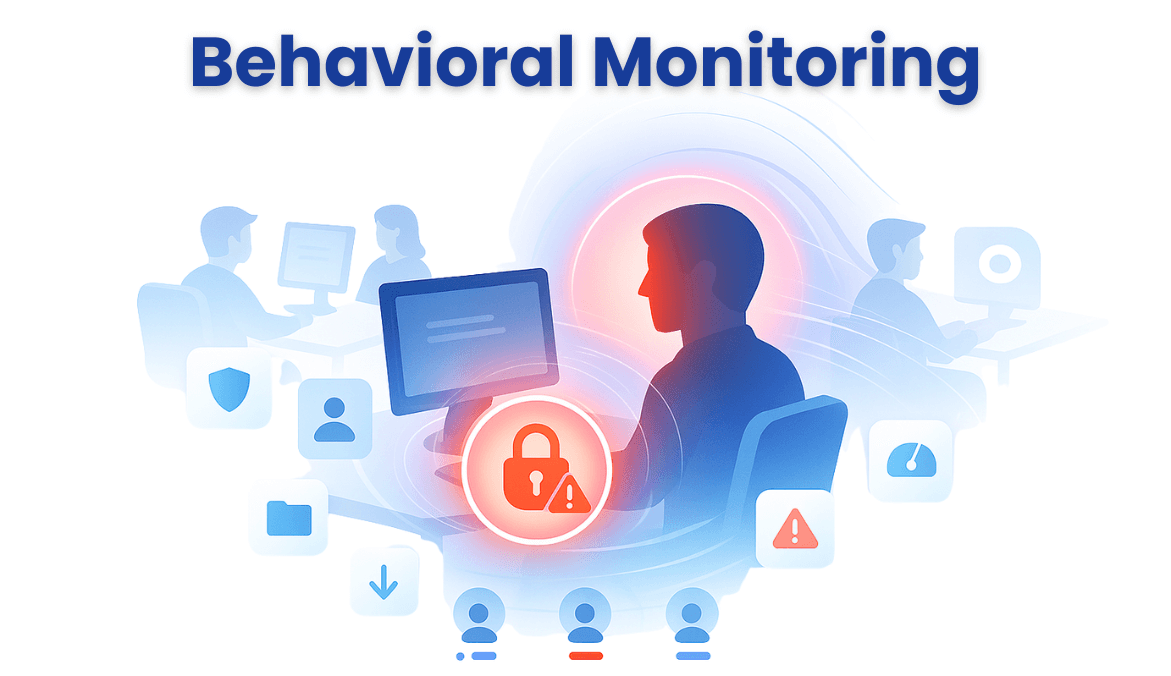
Behavioural monitoring is the process of tracking how employees interact with systems, data, and tools — not just what they did.
Instead of relying on static logs or isolated events, it identifies patterns, such as:
Most insider problems are not malicious — they’re born from stress, disengagement, or carelessness.
2. Remote work multiplied risk
Distributed teams connect from dozens of networks, devices, and environments. Your “perimeter” is no longer a building — it’s everywhere.
3. Compliance expectations are clearer
Regulations increasingly expect continuous monitoring rather than static logs.
4. Traditional monitoring is not enough
Old-school monitoring tools show you what happened. Behavioral monitoring shows you what shouldn’t be happening.
Behavioral Monitoring vs Traditional Monitoring
Traditional monitoring tells you:
Who logged in
What files were accessed
Which websites were opened
What apps were used
Useful, but reactive.
Behavioral monitoring tells you:
Whether this behavior is normal
Whether this access is expected
Whether this pattern is risky
Whether this user profile is changing
This is where early detection becomes possible.
What Behavioral Monitoring Actually Watches
Behavioral monitoring surfaces subtle “digital signals” that often precede incidents.
1. Access & Login Behavior
Look for patterns like:
Logins from unusual locations
Access during odd hours
Multiple failed login attempts
Unexpected privilege escalations
These can indicate compromised credentials or misuse.
2. Data Activity
This is where the most damage happens.
Large or unusual file downloads
Access to privileged folders for the first time
Uploading company data to personal clouds
Copying files to external USB devices
Expert Insight: Years ago, I audited a case where an employee downloaded nearly 20× their normal amount of files over a weekend. Traditional monitoring labelled it “high activity.” Behavioral analytics flagged it as a severe anomaly — and that early alert prevented a major breach.
3. Application & System Usage
Signals include:
Sudden interest in developer tools by non-developers
Usage of anonymizers or file-sharing tools
High activity in apps rarely used by the team
4. HR & Behavioral Context
Behavioral data becomes powerful when combined with real-world context:
Notice period
Performance issues
Conflicts with management
Role changes
Sudden disengagement
A Practical Framework to Detect Risky Actions Early
Think of this as a step-by-step blueprint.
Step 1: Define “Risky Behavior” for Your Organization
Map behaviors that matter:
What data is sensitive?
Which roles have high-risk access?
What patterns indicate misuse?
Every organization’s risks are different.
Step 2: Establish Baselines
You cannot detect anomalies unless you define “normal.”
Track:
Typical login times
Usual file access levels
Normal workflow patterns
Expected app usage
Tools like Mera Monitor help gather this effortlessly.
You don’t need everything at once. Start small → expand gradually.
Step 4: Define Use Cases Instead of Rules
Instead of hundreds of micro-rules, focus on patterns:
“Detect off-hours high-volume downloads.”
“Alert when payroll data is accessed for the first time.”
“Flag anomalies in login behavior.”
Expert Insight: Across every insider threat case I’ve been involved with, rigid rules rarely caught issues early. Behavior scoring consistently identified risks days — sometimes weeks — in advance.
Step 5: Build an Alert & Response Workflow
Who responds to what?
IT checks device-level anomalies
Security validates access-related risks
HR handles behavioral or emotional triggers
Managers intervene early with disengaged employees
This prevents overreaction and avoids fear-driven culture.
Step 6: Continuously Tune Your System
Review monthly:
False positives
High-risk user groups
New app or data patterns
Alert relevance
New forms of insider risks
Real-World Scenarios Where Behavioral Monitoring Helps
Scenario 1: Data Exfiltration Before Resignation
Typical warning signs:
Late-night logins
Accessing client folders never touched before
Copying data to USB drives
Exporting CRM reports in bulk
Behavioral monitoring catches this early.
Scenario 2: Compromised Account Being Misused
Signals:
Logins from two countries in the same hour
Sudden administrator privileges
Accessing servers unrelated to the role
Scenario 3: Disengaged Employee Turning High-Risk
Expert Insight: I once saw a case where a highly capable team member gradually became disengaged. Their productivity dipped, communication dropped, and data access patterns changed. Behavioral signals helped HR intervene early — preventing both security and performance issues.
Not every risk is malicious. Some are emotional or psychological — and still dangerous for the organization.
Tools & Technologies Used in Behavioral Monitoring
30–60–90 Day Roadmap to Launch Behavioral Monitoring
First 30 Days – Foundation
Identify your sensitive data
Align with HR, IT, and legal
Select tools (starting with Mera Monitor for visibility)
Days 31–60 – Baseline & Pilot
Monitor quietly (no enforcement)
Build behavioral baselines
Define your use cases
Days 61–90 – Scale & Integrate
Roll out to more teams
Create incident playbooks
Train managers on interpreting behavioral insights
Final Thoughts
Behavioral monitoring isn’t about catching “bad employees.” It’s about catching small changes before they turn into big risks.
When done ethically — with transparency, role-based access, and the right tools — it becomes one of the most powerful early warning systems a company can build.
Rishi Roy, Head of AI at AAPNA Infotech, is an AI and automation leader with 20+ years of global experience. A keynote speaker and GLG Council Member, he drives enterprise AI adoption, helping organizations scale with automation, predictive intelligence, and innovative solutions.
Thank you for registering for our upcoming webinar on Vryno/Mera Monitor. We’re excited to have you join us and look forward to sharing valuable insights and best practices to enhance your productivity.
Stay tuned for more details, and we’ll see you at the webinar!
Mera Monitor is a powerful and efficient employee tracking app that ensures seamless monitoring and productivity management. With its intuitive interface, real-time tracking, and robust features, it enhances transparency and efficiency.
This tool helps organizations monitor their employees effectively. It helps them to improve productivity and efficiency. The tool is pretty cool because it's got real-time monitoring features, like screen capture, live recording and live streaming with multiple Reports.