What Is a 2-2-3 Work Schedule? (Panama Schedule Explained)
Introduction
If you manage teams that need coverage beyond the standard 9–5, you’ve probably come across the 2-2-3 work schedule. And if you’re here, chances are you’re asking a very practical question: Will this schedule actually work for my team—or will it create more problems than it solves?
After 10+ years working with operations-heavy teams—manufacturing, support centers, security, and service environments—I can tell you this: The 2-2-3 schedule can be incredibly effective—but only when it’s implemented thoughtfully.
Let’s break it down clearly, honestly, and practically.
What Is a 2-2-3 Schedule?
At its simplest, a 2-2-3 schedule is a rotating shift pattern designed for 24/7 coverage.
Here’s how it works:
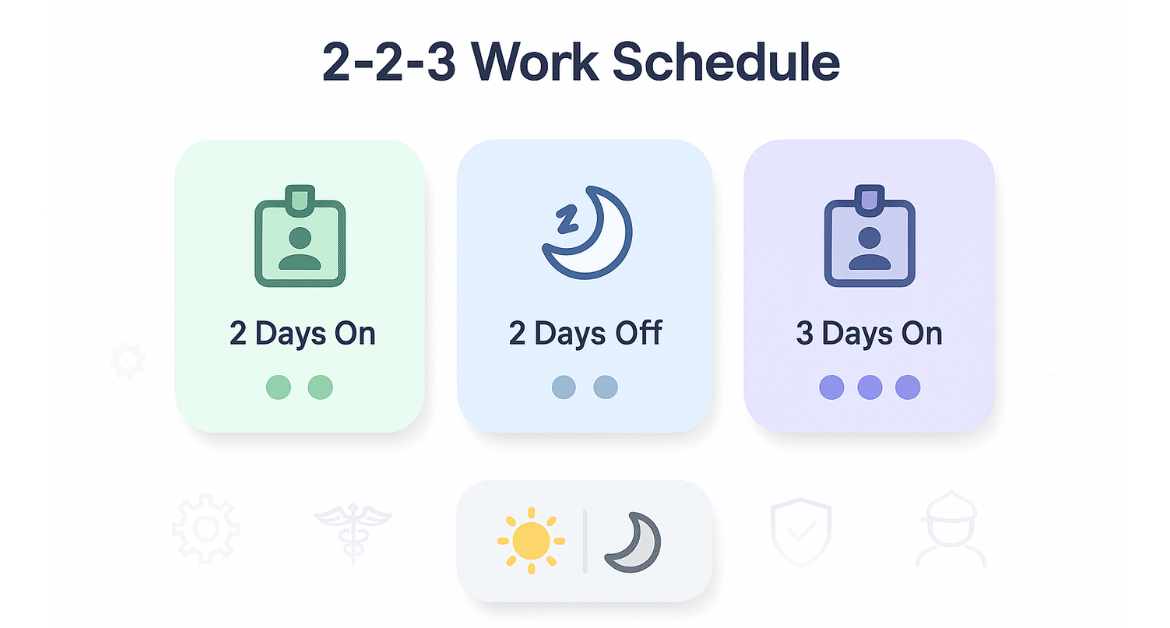
Employees work 2 days on
Then 2 days off
Then 3 days on
The following week, the pattern reverses (2 off, 2 on, 3 off)
Most organizations run this schedule using 12-hour shifts, which allows continuous coverage without overstaffing.
Over the years, I’ve seen teams adopt a 2-2-3 schedule not because it’s trendy, but because it creates predictable rest periods while still supporting round-the-clock operations—especially in environments where fatigue can quickly lead to mistakes.
Why It’s Also Called the Panama Schedule
You’ll often hear the 2-2-3 schedule referred to as the Panama schedule. In practice, the two terms are used interchangeably. Both describe the same rotating pattern that balances long shifts with longer recovery time.
Actionable takeaway: If your operation requires 24/7 coverage and you want fairness in shift distribution, the 2-2-3 schedule is worth serious consideration.
How Does a 2-2-3 Schedule Work? (With a Real Example)
The Two-Week Pattern (Easy View)
A typical two-week cycle looks like this:
Week 1
Work: Monday, Tuesday
Off: Wednesday, Thursday
Work: Friday, Saturday, Sunday
Week 2
Off: Monday, Tuesday
Work: Wednesday, Thursday
Off: Friday, Saturday, Sunday
This repeating work pattern gives employees every other weekend off, which is a major morale booster in shift-based roles.
The Four-Week Rotation (Day ↔ Night Shifts)
In many organizations, teams rotate between:
Day shifts for two weeks
Night shifts for two weeks
In practice, the biggest confusion I’ve seen isn’t the schedule itself—it’s what happens during the first month, especially around:
Shift swaps
Handover gaps
Overtime assumptions
Once those rules are clarified, resistance drops quickly.
Actionable takeaway: Before launch, document swap rules and handover expectations. Most early frustration comes from ambiguity—not the schedule.
Who Uses the 2-2-3 Work Schedule?
The 2-2-3 work schedule is most effective in environments where coverage continuity matters more than fixed office hours.
Industries Where 2-2-3 Works Well
Manufacturing & Production
Continuous operations
Equipment monitoring
Reduced downtime between shifts
Healthcare & Emergency Services
Hospitals, emergency rooms, diagnostics
Fair distribution of day and night shifts
Built-in recovery days between long shifts
Security & Surveillance
Physical security teams
Monitoring and control rooms
Critical infrastructure protection
Utilities & Infrastructure
Power plants, water treatment, telecom operations
Round-the-clock monitoring and incident response
Customer Support & Call Centers
Global or multi-time-zone coverage
Predictable staffing for peak hours
When the 2-2-3 Schedule Is a Poor Fit
Very small teams with limited backup
Roles requiring frequent weekday collaboration
Creative or deep-focus work that suffers under 12-hour shifts
Practical takeaway: If your business needs continuous availability, the 2-2-3 schedule is a strong candidate. If it needs continuous collaboration, reconsider.
Pros and Cons of the 2-2-3 Schedule
Like any shift system, the 2-2-3 schedule comes with clear advantages—and real trade-offs.
Despite longer shifts, employees often work fewer total days annually
Key Challenges
Fatigue Risk
12-hour shifts are physically and mentally demanding
Errors increase when rest is compromised
Fatigue prevalence differs markedly across work schedules, with three-shift workers reporting 28.6% fatigue compared with 18.1% among day workers, reflecting substantial differences that appear early in shift-work exposure.
Schedule Fragility
Absences can disrupt the entire rotation
Poor planning leads to frequent overtime
Research shows that employees working 12-hour and night shifts face a 25–30% higher risk of injury than those on regular daytime schedules, with risk increasing over consecutive shifts—a reminder that fatigue and long hours must be actively managed in any 2-2-3 implementation.
Handover Dependency
Missed handovers cause repeat work or missed incidents
Adaptation Period
First 30–60 days require adjustment for both employees and managers
Practical takeaway: The 2-2-3 schedule succeeds when rest, staffing buffers, and handovers are protected by design—not left to chance.
Variations of the 2-2-3 Schedule
Not every organization runs the same version of a 2-2-3 schedule. Several variations exist.
Common Variants
Classic 2-2-3 (Panama Schedule)
Two weeks days, two weeks nights
Most widely used version
Pitman Schedule
Similar rotation but structured slightly differently
Often grouped under the same family of schedules
Fixed-Day or Fixed-Night Variant
Employees stay permanently on days or nights
Used when rotation causes fatigue or retention issues
Modified 2-2-3
Adjusted start times
Additional rest days after night rotations
How to Choose the Right Variation
Consider:
Fatigue tolerance of your workforce
Local labor regulations
Employee preferences
Training and supervision needs
Practical takeaway: Choose the version that fits your people and operations, not the one that looks best on paper.
Staffing Math: How Many People Do You Need?
This is where many 2-2-3 schedules fail—understaffing.
The Baseline Rule
For one position requiring 24/7 coverage:
You need 4 full-time employees to run a basic 2-2-3 rotation
Add a Relief Factor (Strongly Recommended)
To cover:
Vacations
Sick leave
Training
Unexpected absences
Plan for a relief factor of 1.25.
That means:
5 employees for every 4-person rotation
Simple Formula
Required headcount = Number of posts × 4 × Relief factor
Practical takeaway: If you don’t plan for absences, managers will pay for it later—with burnout and constant rescheduling.
How to Implement a 2-2-3 Schedule Without Burning People Out
Implementation matters more than the schedule itself.
Step 1: Set Rules Before You Publish the Schedule
Define clearly:
Overtime limits
Shift swap policies
Call-out and coverage rules
Escalation paths
Ambiguity creates resentment fast.
Step 2: Design Strong Shift Handovers
Handover failures are one of the biggest risks in 2-2-3 schedules.
A simple handover checklist should include:
What happened during the shift
Pending issues or follow-ups
Risks or incidents
Who owns the next action
Step 3: Build Fatigue
Protection Into the System Mandatory breaks
Reasonable shift start times
Extra recovery time after night rotations
No “silent” overtime expectations
Step 4: Train Supervisors Properly
Supervisors must:
Understand the rotation deeply
Spot early fatigue signals
Enforce rules consistently
Practical takeaway: A well-designed schedule still fails without trained supervisors to support it.
Tracking Time, Attendance, and Productivity on a 2-2-3 Schedule
Shift schedules change how productivity should be measured.
According to occupational health research, roughly 17.7% of U.S. employees work non-traditional shifts, many involving extended hours; these schedules have been linked to increased fatigue, safety risks, and diminished performance without proper monitoring and fatigue controls.
Practical takeaway: Compare productivity by shift type and workload, not just by individuals.
Is a 2-2-3 Schedule Right for Your Team? (Quick Check)
Answer honestly:
Do we need 24/7 or extended-hour coverage?
Can we staff at least four rotating teams reliably?
Do we have strong handover discipline?
Can we manage fatigue proactively?
Are supervisors trained to handle shift operations?
How to Decide
Mostly “Yes” → 2-2-3 is likely a good fit
Mostly “No” → Consider simpler or fixed schedules first
Practical takeaway: The right schedule is the one your team can sustain—not the one that looks efficient on paper.
Practical takeaway: Momentum and transparency in the first 90 days determine long-term acceptance.
Final Thought
The 2-2-3 work schedule isn’t a magic solution—it’s a system. When designed with clear rules, proper staffing, and visibility into real work, it can deliver both operational reliability and employee balance.
When rushed or under-resourced, it creates stress quickly.
Get the design right, and the schedule will support your team—not exhaust it.
Shashikant Tiwari is a digital marketing strategist with extensive experience in SEO, content strategy, and B2B SaaS marketing. At Mera Monitor, he creates actionable resources that help businesses track productivity, boost accountability, and empower teams to perform at their best.
Thank you for registering for our upcoming webinar on Vryno/Mera Monitor. We’re excited to have you join us and look forward to sharing valuable insights and best practices to enhance your productivity.
Stay tuned for more details, and we’ll see you at the webinar!
Mera Monitor is a powerful and efficient employee tracking app that ensures seamless monitoring and productivity management. With its intuitive interface, real-time tracking, and robust features, it enhances transparency and efficiency.
This tool helps organizations monitor their employees effectively. It helps them to improve productivity and efficiency. The tool is pretty cool because it's got real-time monitoring features, like screen capture, live recording and live streaming with multiple Reports.
Its designed to enhance workplace productivity and efficiency. The tool offers real-time monitoring capabilities, including live streaming and screen capturing, which have been highlighted as unique features.