The Productivity Visibility Framework (Effort → Output → Outcome)
Introduction
When leaders talk about productivity, many still reach for hours logged or status updates. But anyone who’s led teams for long knows that busyness doesn’t equal progress.
Some fascinating research shows why this matters: 77% of remote employees report greater productivity when working offsite, and hybrid teams can be about 5% more productive than fully remote or office-only teams, depending on how work is structured.
But raw percentages miss a deeper point: if you don’t connect the dots between effort, output, and outcome, even good performance indicators can lie to you.
In my 20+ years working with delivery, IT, and operations teams across sectors, I’ve rarely seen productivity issues that weren’t rooted in visibility problems—not effort problems. This article walks you through a practical framework to see productivity clearly and meaningfully.
What Is the Productivity Visibility Framework?
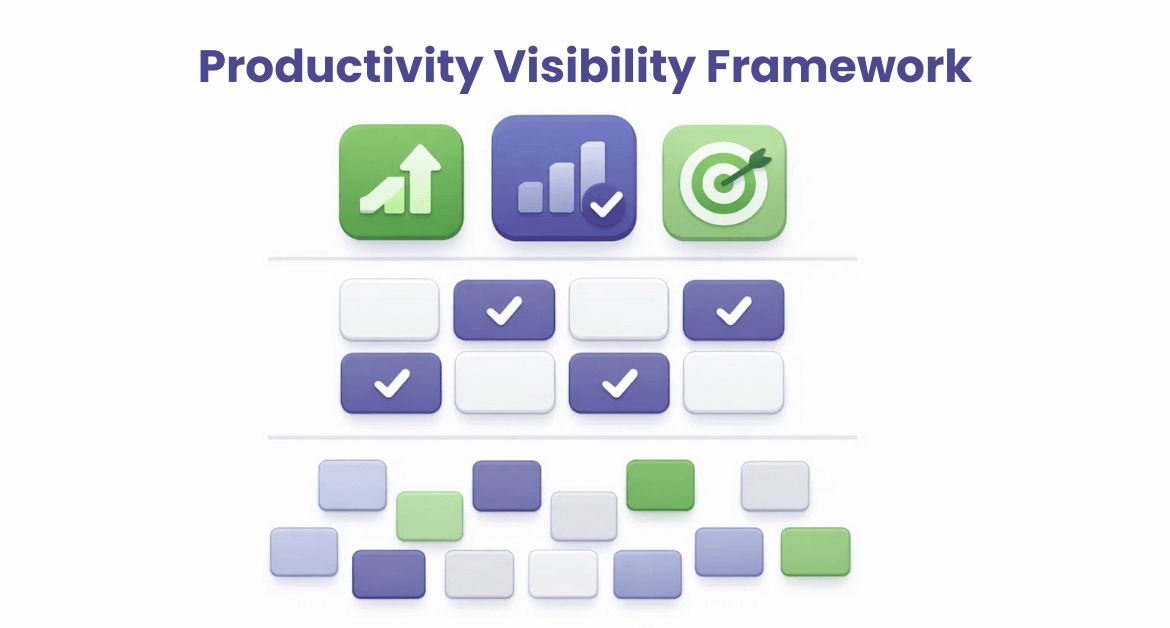
The Productivity Visibility Framework breaks work into three connected parts:
Effort: what people invest (time, attention, focus)
Output: what gets delivered (tasks, deliverables, quality)
Outcome: what actually changes (impact, value)
The framework answers a core leadership question: How do we know that work being done truly drives value?
Stat to know: In a two-year study of more than 800,000 employees, researchers found that productivity stayed stable or improved after transition to remote work, showing real performance doesn’t depend on where work appears to happen.
Actionable takeaway: If you can’t explain how day-to-day effort leads to business outcomes in one or two sentences, you don’t have visibility—you have noise.
Why Most Productivity Tracking Fails
Presence Metrics Mislead
People often think tracking hours or active status equals productivity. But that’s like counting steps during a hike without checking whether you reached the summit.
Isolating One Layer Skews Behavior
Track only effort → people optimize for busy signals
Track only output → teams hit numbers without impact
Track only outcomes → feedback is delayed and reactive
Across multiple organizations I’ve worked with, teams that focused heavily on hours logged seemed busy—but they consistently delivered slow, misaligned results.
Stats confirm this challenge: Highly engaged employees can be 14% more productive in production and 18% more productive in sales performance than less engaged peers, illustrating that engagement and clarity matter more than simple activity.
Actionable takeaway: If a metric doesn’t help a team member make a better decision this week, it isn’t a productivity metric—it’s a distraction.
The Three Layers Explained (With Real Examples)
Layer 1: Effort (Leading Indicators)
Effort isn’t “hours logged”; it’s about where attention and energy are spent.
Good effort signals include:
Blocks of focus time
Work-in-progress balance
Response latency in collaboration
Examples by role:
Support: number of active and prioritized tickets
Engineering: real focus time on development work
HR/Ops: time spent on key processes vs. interruptions
Actionable advice: Limit effort tracking to 3–5 signals max per team. Too many just adds noise.
Layer 2: Output (Work Delivered)
Outputs are clear deliverables that can be evaluated:
Tickets closed
Features released
SOPs completed
Campaigns launched
Outputs must be:
Defined clearly
Tied to team priorities
Reviewed and validated
Actionable advice: If a task doesn’t have a clear “done” criteria, refine it before adding it to output metrics.
Layer 3: Outcome (Value Created)
Outcomes answer: What changed because this work was done?
Examples:
Shorter resolution times
Higher customer satisfaction
Lower defect rates
Increased revenue or retention
Outcomes are lagging indicators—you see them after the fact, but they tell you what truly matters.
Actionable advice: Pick 1–2 outcomes per team; too many dilute focus.
How to Use the Framework (Step-by-Step)
Step 1: Start with Outcomes
Ask: If this team performs well, what measurable change do we see in business performance?
Be specific: Cycle time, SLA improvements, first-time quality, net revenue influenced.
Step 2: Define Outputs
Map each outcome to 2–4 direct outputs. If you cannot draw a line from effort to outcome through output, revisit the definition.
Step 3: Choose Predictive Effort Signals
Useful effort signals are those that:
Predict output quality
Identify bottlenecks early
Highlight overload or misalignment
Step 4: Set Practical Thresholds
Define what good looks like with ranges, not rigid numbers. Use Green / Amber / Red instead of single targets.
Step 5: Review Regularly—but Briefly
Daily: short team sync
Weekly: manager-level cadence
Monthly: leadership trend review
Reviews are not status meetings; they’re decision forums. Make them count.
The Framework in Action: One Scenario
High Effort, Low Output
You see effort high but output low—a common pattern.
In teams I’ve coached, this is almost always due to:
The Productivity Visibility Framework is a way to understand productivity by connecting effort, output, and outcome. Instead of relying only on hours worked or activity levels, it helps teams see how daily work actually translates into meaningful business results.
Hours worked only show presence, not progress. Two people can work the same number of hours and produce very different results. Productivity improves when teams understand how effort turns into outputs and outcomes, not when they simply track time.
By focusing on patterns and trends rather than individual behavior. Tracking effort signals (like focus time or workload balance), combined with outputs and outcomes, provides visibility without constant oversight or invasive monitoring.
Remote and hybrid teams often lack visibility into how work flows. This framework replaces assumptions with clear signals, helping leaders support teams without relying on constant check-ins or online presence indicators.
Transparency about what is tracked—and why—builds trust. When data is used to improve processes rather than judge individuals, teams feel supported instead of monitored.
Rishi Roy, Head of AI at AAPNA Infotech, is an AI and automation leader with 20+ years of global experience. A keynote speaker and GLG Council Member, he drives enterprise AI adoption, helping organizations scale with automation, predictive intelligence, and innovative solutions.
Thank you for registering for our upcoming webinar on Vryno/Mera Monitor. We’re excited to have you join us and look forward to sharing valuable insights and best practices to enhance your productivity.
Stay tuned for more details, and we’ll see you at the webinar!
Mera Monitor is a powerful and efficient employee tracking app that ensures seamless monitoring and productivity management. With its intuitive interface, real-time tracking, and robust features, it enhances transparency and efficiency.
This tool helps organizations monitor their employees effectively. It helps them to improve productivity and efficiency. The tool is pretty cool because it's got real-time monitoring features, like screen capture, live recording and live streaming with multiple Reports.
Its designed to enhance workplace productivity and efficiency. The tool offers real-time monitoring capabilities, including live streaming and screen capturing, which have been highlighted as unique features.