Introduction
Outsourcing is no longer a cost-saving tactic — it has become the backbone of modern business. From IT and design to accounting and customer service, companies worldwide rely on outsourced teams to deliver efficiency, flexibility, and expertise. But with this growth comes a big question: how do you ensure productivity without falling into the trap of surveillance?
This tension isn’t new. Just this September 2025, Zoho ran a bold advert declaring: “Stop trading privacy for productivity.” It struck a chord, highlighting what many outsourced workers already feel — that monitoring can slide into micromanagement, eroding trust. The real challenge for businesses is balancing accountability, transparency, and respect for privacy.
That’s where Mera Monitor comes in.
The Challenge: Productivity at a Distance
Managing outsourced work is not simple. Teams are often spread across cities, countries, or even continents.
Add to this:
- Different time zones and work cultures.
- A lack of visibility into daily work.
- The ever-present risk of miscommunication.
Employers worry: “Are my outsourced teams working effectively?” Outsourced workers worry: “Will my hard work be recognized, or will I just be another screen watched?”
Traditional surveillance-heavy monitoring tools haven’t helped this relationship. They may log keystrokes, snap intrusive screenshots, or even stream live feeds of desktops. The result? Distrust on both sides.
Why Surveillance Fails
Surveillance-based monitoring creates fear, not focus. Employees feel scrutinized, not supported. Productivity becomes about avoiding punishment rather than delivering value. In outsourced relationships , already built on fragile trust , this approach can backfire fast.
Here’s what surveillance often misses:
- Context: Idle time could be brainstorming, not slacking.
- Engagement: A sense of autonomy motivates more than constant oversight.
- Trust: Surveillance signals distrust, which undermines loyalty.
Outsourced work thrives on partnership, not policing.
Mera Monitor’s Approach: Transparency, Not Intrusion
Mera Monitor was built on a simple philosophy: help teams see clearly, without spying.
Core Principles
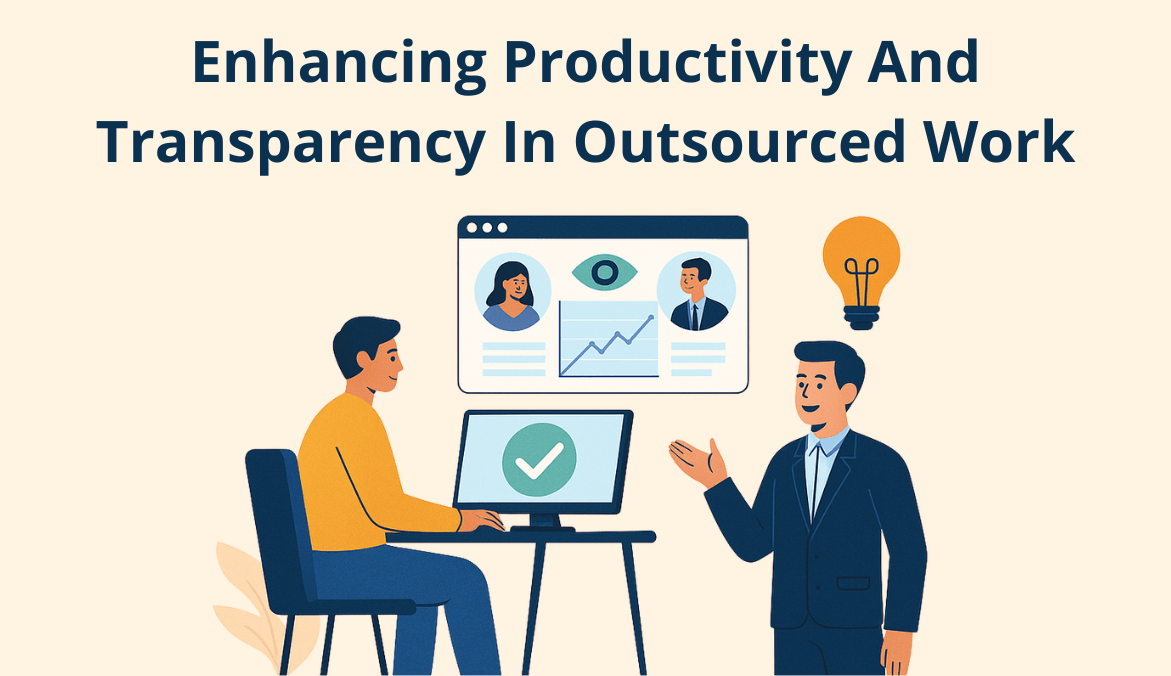
- Transparency for Both Sides – Workers and managers see the same dashboards. Everyone has clarity on active hours, task focus, and project allocation.
- Self-Monitoring for Empowerment – Employees use Mera Monitor to prove effort, claim missed time, and even highlight process inefficiencies.
- Privacy Built-In – Options like blurred screenshots and private mode ensure personal space is respected.
Key Features
- Activity Monitoring: Track Active, Idle, and Away time to spot productivity patterns.
- Application & URL Tracking: See which tools are being used — no keystroke logging, just clarity on focus.
- Productivity Breakdown: Distinguish productive hours from distractions, giving managers and employees actionable insights.
- Private Mode: Workers can pause tracking during breaks or personal time.
- Customizable Controls: Admins can adjust screenshot intervals, blur sensitive content, or limit live recording access.
Together, these features foster accountability without micromanagement.
Benefits for Outsourced Workers
Mera Monitor flips the narrative: it’s not just for managers, it’s for employees too.
- Proof of Work – No more “invisible labor.” Workers can showcase their contribution transparently.
- Fair Recognition – Features like time-claim let employees correct errors if work wasn’t logged.
- Autonomy with Accountability – Private mode ensures personal space while maintaining trust.
“About 20% of Mera Monitor’s benefits come from monitoring. The other 80% come from empowering staff to manage their own time more effectively.”
Benefits for Employers and Managers
For leaders managing outsourced teams, Mera Monitor provides clarity without complexity.
- Efficiency at Scale – One client, Target Integration, reported a 30% productivity increase within weeks.
- Project Transparency – Know exactly how much time is spent on each client or task.
- Reduced Micromanagement – Instead of constant check-ins, managers rely on real-time dashboards.
- Better Decision-Making – Data-driven insights help identify bottlenecks and improve workflows.
Case Study: Target Integration
Target Integration, one of India’s largest CRM resellers, adopted Mera Monitor for their distributed teams. Within the first month, they reported:
- 30% increase in productivity.
- Improved employee accountability.
- Reduced time wasted in meetings.
Their leadership summed it up: “It feels like we finally have a clear lens into our team’s performance. It’s a game-changer.”
The Bigger Picture: Outsourcing Built on Trust
The outsourced economy is projected to grow faster than in-house hiring in the coming decade. Businesses that master trust + transparency will win. Workers want fairness; employers want visibility. Surveillance breaks the balance. Transparency strengthens it.
Mera Monitor positions itself as the productivity partner — not a watchdog. By providing clarity without intrusion, it helps outsourced relationships flourish.
Surveillance Tools vs Transparency Tools
| Surveillance Tools | Mera Monitor Transparency |
|---|---|
| Keystroke logging | Activity patterns (Active/Idle/Away) |
| Intrusive screenshots | Blurred, customizable screenshots |
| Hidden tracking | Employee-visible dashboards |
| Fear-driven compliance | Trust-driven accountability |
| Micromanagement | Empowerment & autonomy |
Conclusion: A Shared Picture of Productivity
Outsourced work is about more than contracts. It’s about trust between people who may never share an office but must share outcomes. Surveillance undermines that trust. Transparency builds it.
Mera Monitor helps create a shared picture of productivity — one that employees and employers can both trust. The result? Stronger partnerships, higher efficiency, and teams that thrive no matter where they work.
Ready to explore Mera Monitor? Start your free 14-days trial today and see how transparency transforms outsourced work.