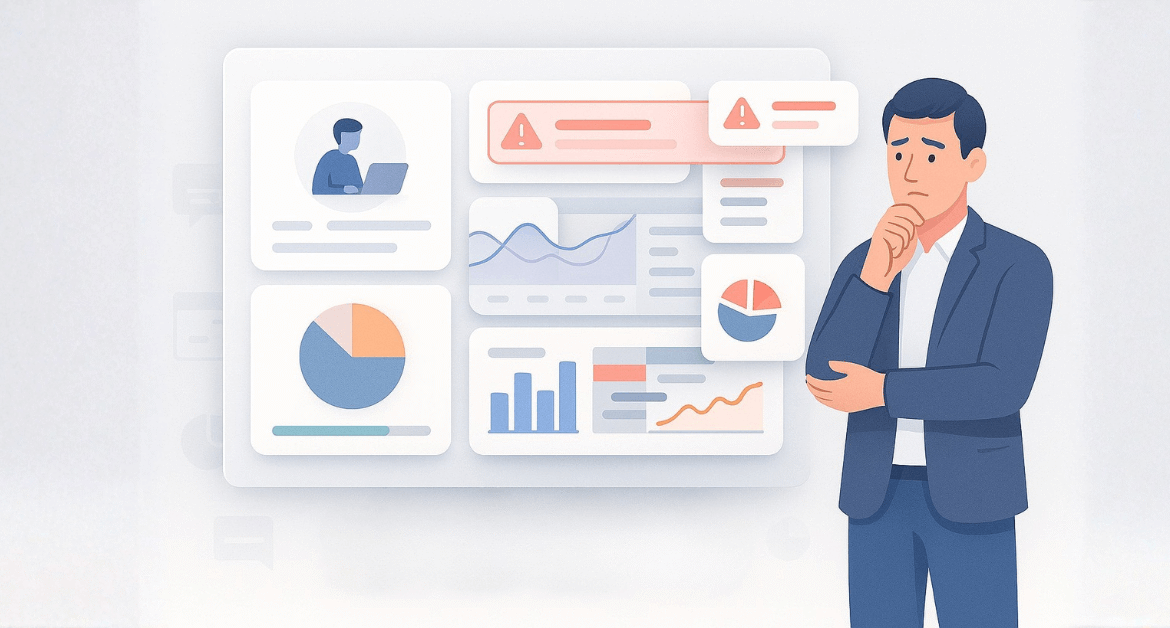
Common Employee Monitoring Mistakes That Destroy Trust

    Common Employee Monitoring Mistakes (And How to Avoid Them)

Introduction

Employee monitoring often starts with good intentions.

Leaders want visibility. Teams want fairness. Businesses want better productivity and security. Yet, despite these goals, employee monitoring frequently backfires—causing distrust, resistance, and poor data that helps no one.

Monitoring isn’t rare — it’s widespread. According to a survey, 96% of companies use time-tracking or monitoring software, and about 70% of larger enterprises actively monitor staff activity.

This illustrates why designing monitoring right matters more than ever.

The issue isn’t employee monitoring itself. It’s how it’s designed, introduced, and used.

In my 10+ years working with growing teams and enterprise environments, I’ve seen employee monitoring fail far more often due to poor communication than poor technology.

This guide breaks down the most common employee monitoring mistakes, why they happen, and—more importantly—how to avoid them without damaging trust or morale.

What People Really Mean When They Search “Employee Monitoring Mistakes”

Most people aren’t looking for theory. They’re asking practical questions like:

  • “Why did morale drop after we introduced monitoring?”
  • “Are we monitoring too much?”
  • “How do we avoid micromanaging?”
  • “Could this get us into legal trouble?”

If those questions sound familiar, you’re in the right place.

12 Common Employee Monitoring Mistakes (And How to Fix Them)

1. Monitoring Without Transparency

This is the fastest way to lose trust.

When employees aren’t clearly told what is being monitored, why it’s monitored, and how the data will be used, monitoring quickly feels secretive—even if it’s legal.

I’ve worked with teams where productivity dropped—not because monitoring existed, but because employees discovered it informally rather than through leadership communication.

How to avoid it:

  • Communicate openly before rollout
  • Share the purpose, scope, and boundaries
  • Answer questions upfront

Transparency isn’t optional—it’s foundational.

2. Collecting Too Much Data “Just in Case”

More data does not mean better insight.

Tracking everything often leads to:

  • Data overload
  • Privacy concerns
  • Confusion about what matters

How to avoid it:

  • Start with the minimum data needed
  • Track outcomes and patterns—not every click
  • Expand only when there’s a clear reason

Less data, used well, beats more data used poorly.

When it comes to data, more isn’t always better. Research on information overload shows that when people face too much information, decision quality can suffer because the brain’s capacity to process all the details is exceeded — a concept central to avoiding data overload in employee monitoring.

3. Tracking Personal Activity or After-Hours Behavior

Monitoring personal activity—even unintentionally—creates serious trust and compliance risks.

This includes:

  • Personal messages
  • Off-hours usage
  • Non-work-related browsing

How to avoid it:

  • Clearly define work hours
  • Exclude personal activity
  • Respect boundaries consistently

Employee monitoring should stop where personal time begins.

Employee perceptions matter. A 2024 Forbes Advisor survey found that 36% of employees feel monitoring negatively affects their job satisfaction, while only about 30% see it as beneficial—highlighting how poorly executed monitoring can damage engagement.

4. Confusing Activity with Productivity

This is one of the most subtle—and damaging—mistakes.

High activity doesn’t always mean high value. Quiet focus often produces the best work.

Across multiple implementations I’ve been part of, teams that relied purely on activity signals consistently misjudged their strongest performers.

How to avoid it:

  • Look at trends, not isolated spikes
  • Pair time data with task or outcome context
  • Focus on results, not busyness

5. Using Monitoring as a Control Tool

When monitoring feels like policing, people adapt their behavior—not their performance.

This leads to:

  • “Looking busy” instead of doing meaningful work
  • Fear-driven behavior
  • Reduced engagement

How to avoid it:

  • Use data for coaching, not calling out
  • Review trends at team level first
  • Focus on improvement, not enforcement

Monitoring should support people—not pressure them.

6. Ignoring Legal and Compliance Requirements

Many organizations assume tools handle compliance automatically. They don’t.

Common gaps include:

  • No formal policy
  • No employee notice
  • No data retention rules

How to avoid it:

  • Document your monitoring approach
  • Ensure legal alignment for your region
  • Review policies regularly

Compliance is not a checkbox—it’s an ongoing responsibility.

7. Not Having a Written Monitoring Policy

Without a policy, decisions become inconsistent and subjective.

A good policy should clearly explain:

  • What is monitored
  • Why it’s monitored
  • Who can access the data
  • How long data is retained

Clarity protects both employees and the organization.

8. Giving Too Many People Access to Monitoring Data

Access without boundaries invites misuse—sometimes unintentionally.

How to avoid it:

  • Use role-based access
  • Limit visibility to what’s necessary
  • Maintain an audit trail

Data should be visible to the right people for the right reasons.

9. Reviewing Data Too Frequently

Daily scrutiny leads to noise, not insight.

Short-term fluctuations are normal. Overreacting creates unnecessary pressure.

How to avoid it:

  • Review data weekly or bi-weekly
  • Focus on patterns, not single days
  • Use alerts for exceptions—not constant checks

10. Rolling Out Monitoring Without Manager Training

Even the best tools fail when managers don’t know how to use them properly.

In the most successful rollouts I’ve seen, leaders spent more time preparing managers for conversations than configuring the monitoring tool itself.

How to avoid it:

  • Train managers on interpretation
  • Provide guidance on conversations
  • Emphasize coaching over control

11. Not Sharing Insights Back With Employees

When data only flows upward, monitoring feels extractive.

How to avoid it:

  • Share team-level insights
  • Show how data leads to improvements
  • Close the feedback loop

Visibility builds trust when it’s shared.

12. Failing to Act on What the Data Shows

Monitoring without action is pointless.

If insights don’t lead to:

  • Process changes
  • Better planning
  • Fairer workloads

…then employees will stop caring.

Data must drive decisions—or it becomes noise.
A Simple Framework to Avoid Most Monitoring Mistakes

Clarity → Consent → Context → Coaching

  • Clarity: Define purpose and success metrics
  • Consent: Communicate openly and respectfully
  • Context: Interpret data with role and workload awareness
  • Coaching: Use insights to support improvement

This framework alone prevents most failures.

What You Should Monitor (And What You Should Avoid)

Monitor responsibly:

  • Task and project time
  • Team-level productivity trends
  • Security-related behavior

Avoid or heavily restrict:

  • Personal communications
  • Webcam or audio tracking
  • Off-hours monitoring

If it feels invasive, it probably is.

How Mera Monitor Helps Teams Avoid These Mistakes

Tools can either amplify mistakes—or prevent them.

Mera Monitor is designed to support ethical, transparent monitoring by:

  • Offering role-based access to prevent misuse
  • Providing trend-focused dashboards instead of raw surveillance
  • Allowing clear tracking boundaries
  • Supporting productivity improvement rather than micromanagement

The goal is visibility with context—not control. Signup Now

Final Thoughts

Employee monitoring succeeds when it’s:

  • Transparent
  • Proportionate
  • Improvement-focused

When trust leads, monitoring becomes a tool for clarity—not conflict.

Avoid these common mistakes, and monitoring can genuinely support both performance and people.

FAQs

The most common employee monitoring mistakes include lack of transparency, over-collecting data, confusing activity with productivity, ignoring privacy boundaries, and using monitoring as a control mechanism instead of a support tool.

Yes, employee monitoring can reduce productivity if it feels invasive, excessive, or punitive. When monitoring creates fear or micromanagement, employees focus on appearing busy rather than doing meaningful work.

To avoid micromanagement, monitor trends instead of individuals, focus on outcomes rather than activity, review data periodically (not daily), and use insights for coaching and improvement—not enforcement.

Employee monitoring is generally legal when done transparently and in compliance with local labor and data protection laws. Employers must clearly inform employees about what is monitored, why it is monitored, and how the data is used.

Employers should avoid monitoring personal communications, webcam or audio recordings, non-work-related activity, and employee behavior outside working hours. Monitoring should stop where personal privacy begins.

Transparency builds trust. When employees understand what is being monitored and why, they are more likely to accept monitoring as a productivity tool rather than a surveillance system.

Monitoring data should typically be reviewed weekly or bi-weekly to identify trends and patterns. Reviewing data too frequently can lead to overreaction and unnecessary pressure on employees.

Ethical employee monitoring focuses on clarity, consent, context, and coaching. It uses minimal data, respects privacy, and supports employees through better planning, fair workloads, and continuous improvement.

The biggest mistake is assuming the software alone will solve productivity problems. Without proper communication, policies, and manager training, even the best monitoring tools can damage trust and morale.

Sharing insights helps employees understand how data is used, improves trust, and turns monitoring into a collaborative improvement process rather than a one-sided control system.

Author

  • Shashikant Tiwari is a digital marketing strategist with extensive experience in SEO, content strategy, and B2B SaaS marketing. At Mera Monitor, he creates actionable resources that help businesses track productivity, boost accountability, and empower teams to perform at their best.

NCR CHRO Roundtable 2026

ROI of Workforce Productivity: Myth vs Reality

Invite-only | CHROs & Senior People Leaders

Noida & Gurgaon   28 Feb 2026

Register Now: