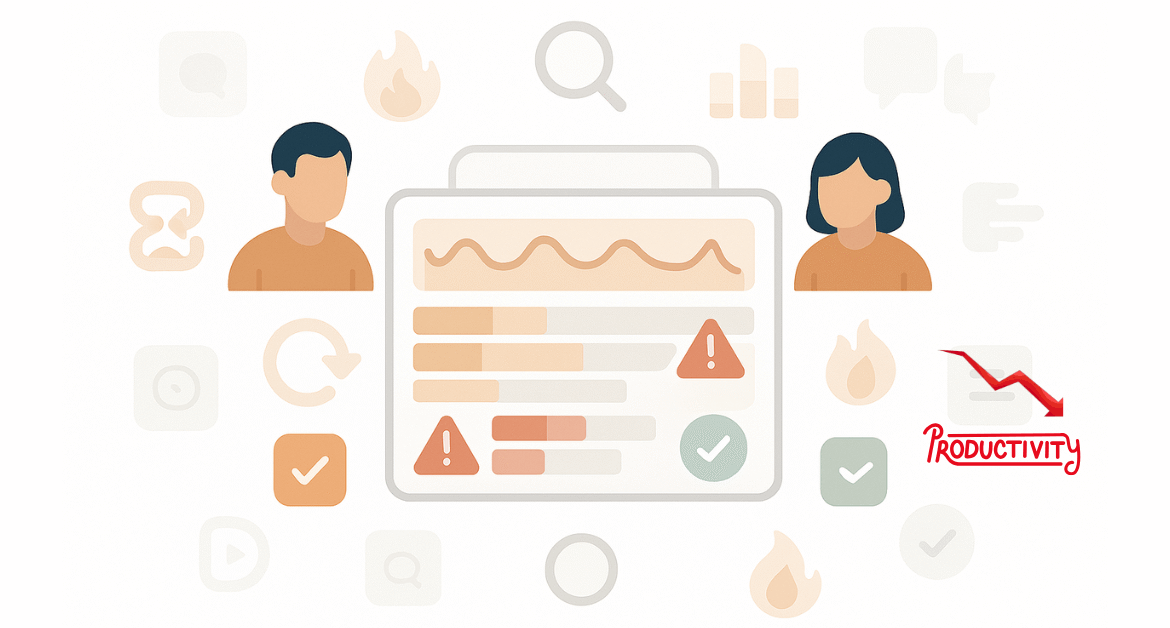
Productivity Red Flags Managers Must Spot Early (Guide)

    Productivity Red Flags Managers Should Never Ignore (And What to Do About Them)

Introduction

Most productivity problems don’t arrive with an alarm.

They creep in quietly missed deadlines here, slower responses there, lots of visible activity but very little meaningful progress.

And by the time leaders react, the damage is already done.

In my 10+ years working with managers across delivery, IT, and operations teams, the earliest productivity problems almost always showed up as patterns, not sudden failures. The challenge wasn’t spotting them—it was knowing which signals mattered and which ones were just noise.

This guide breaks down the productivity red flags managers should never ignore, what they usually mean, and what you can do—without jumping to blame or micromanagement.

What Are Productivity Red Flags?

Productivity red flags are early warning signs that something in the system isn’t working as intended.

They don’t automatically mean people are lazy, disengaged, or underperforming. More often, they point to:

  • unclear expectations
  • overload
  • broken processes
  • poor prioritization
  • unhealthy work patterns

The key distinction to make as a manager is this: A bad week is normal. A repeating pattern is a red flag.

Red flags vs normal performance dips

Everyone has off days. Projects hit bumps. Work ebbs and flows.

Red flags emerge when the same issues keep repeating despite effort, time, and communication. That’s when it’s time to look deeper—not harder.

Before diving into individual behavior, pause and ask yourself three questions:

  1. Are expectations truly clear?
    If people can’t clearly define what “good” looks like, productivity will suffer.
  2. Is the system creating friction?
    Too many meetings, unclear ownership, constant priority changes—these drain output fast.
  3. Are you measuring outcomes or just activity?
    High visibility doesn’t always equal high productivity.

Actionable advice: If you’re unclear on priorities, outcomes, or success metrics, your team probably is too.

The 12 Productivity Red Flags Managers Should Watch

For each red flag below, focus on patterns, not isolated incidents.

1. Deadlines Are Missed Repeatedly

Occasional delays happen. Consistent ones signal deeper issues.

What it usually means:

  • unrealistic timelines
  • unclear scope
  • overload
  • dependencies not being managed

What to do: Review how work is being estimated and whether priorities are shifting midstream.

2. Output Drops, but Activity Looks High

This is one of the most common—and misunderstood—productivity red flags.

People appear busy. Calendars are full. Tools show constant activity. Yet delivery slows.

I’ve repeatedly seen teams where dashboards looked “full” but outcomes stalled—usually because meetings, handoffs, and context switching quietly replaced deep work.

What to do: Audit meetings, reduce work-in-progress, and protect focused work time.

3. Quality Declines or Rework Increases

When mistakes increase or work needs frequent correction, productivity is already compromised.

What it usually means:

  • burnout
  • rushed work
  • unclear requirements
  • lack of feedback loops

What to do: Slow down briefly to fix clarity and workload issues before pushing for speed.

4. Goals Are Missed Despite “Trying Hard”

Effort without results is a system failure, not a motivation issue.

What to do: Break goals into clearer milestones and confirm ownership at each step.

5. Time Feels “Lost” During the Day

Teams struggle to explain where time actually goes.

What it usually means:

  • constant interruptions
  • too many meetings
  • poor task breakdown

Recent research shows employees now spend an average of 11.3 hours per week in meetings, with 35% of meetings rated as unproductive — meaning hundreds of hours each year are consumed by routine interaction rather than meaningful work.

What to do: Identify the biggest time drains and remove just one per week.

6. Disengagement Signals Start Appearing

Low participation, delayed responses, minimal initiative—these often show up quietly.

One pattern that stands out over the years is that disengagement rarely starts with attitude—it starts with sustained overload and unclear priorities.

According to Gallup’s 2025 global workplace report, only about 21% of employees worldwide are engaged at work, meaning only roughly one in five workers feel connected and committed to what they do — a metric closely tied to long-term productivity and business outcomes.

What to do: Check workload balance and clarify what truly matters right now.

7. Absenteeism or Lateness Increases

This isn’t always a discipline issue.

What it usually means:

  • stress
  • low morale
  • lack of ownership

What to do: Have a conversation focused on obstacles, not attendance numbers.

8. Work Is Always “In Progress,” Rarely Finished

Tasks move, but nothing seems to close.

What to do: Limit how many tasks can be active at once and define “done” clearly.

9. Communication Breaks Down

Messages are missed. Handovers fail. Updates are vague.

A recent business communication study found that 43% of leaders say poor communication decreases productivity, and 42% link it to missed deadlines — making communication breakdown one of the top structural causes of chronic output issues.

What to do: Simplify communication channels and clarify who owns next steps.

10. Everything Feels Urgent

When everything is a priority, nothing is.

What to do: Force-rank priorities weekly. Make trade-offs explicit.

11. Burnout Conversations Increase

Stress becomes normal. Fatigue is visible.

What to do: Revisit workload distribution and stop rewarding unsustainable pace.

12. “Work About Work” Starts Taking Over

Excessive reporting, tracking, and status updates replace real execution.

What to do: Cut low-value reporting and replace it with outcome-focused reviews.
Red Flag Severity Levels (So You Don’t Overreact)

Not every red flag requires the same response.

  • Yellow: early patterns forming (2–3 weeks)
  • Orange: visible impact on delivery or quality
  • Red: morale, attrition, or client risk

From experience, the biggest mistake managers make is waiting for a red-level crisis before acting—most productivity issues are far easier to fix at the yellow stage.

Actionable advice: Intervene early and lightly. Heavy responses too soon create fear.

The Fast Fix Playbook

What to do in the next 48 hours

  • Clarify top priorities
  • Remove one unnecessary meeting
  • Reconfirm ownership and deadlines

What to fix in 2 weeks

  • Reduce overload
  • Improve task clarity
  • Establish regular check-ins

What to build in 30 days

  • Outcome-based metrics
  • Fair visibility into work
  • A coaching rhythm instead of constant monitoring

How to Talk About Productivity Without Killing Motivation

The way you discuss productivity matters as much as what you measure.

A simple coaching framework: “Here’s what I’m noticing → here’s what good looks like → what’s blocking progress → how can I help?”

Avoid:

  • public comparisons
  • daily policing
  • focusing on activity instead of outcomes

Actionable advice: Productivity conversations should feel supportive, not investigative.

How to Prevent These Red Flags from Coming Back

Sustainable productivity requires:

  • clear expectations
  • realistic workloads
  • visibility into work (not surveillance)
  • consistent coaching

When teams understand priorities and feel supported, red flags appear less often—and are easier to fix when they do.

Final Thoughts

Productivity red flags are not warnings of failure—they’re opportunities for course correction.

Managers who spot them early, respond thoughtfully, and fix systems instead of blaming people build teams that perform better and last longer.

That’s not just good management. It’s sustainable leadership.

FAQs

Productivity red flags are early warning signs such as missed deadlines, declining quality, disengagement, and high activity with low output. These signals suggest underlying issues in workload, clarity, or processes rather than individual effort.

By watching for patterns over time, not one-off issues. Repeated delays, unclear ownership, and rising rework are common early indicators.

Yes. High activity often masks inefficiencies like context switching, meeting overload, and unclear priorities.

By focusing on outcomes, coaching conversations, and removing blockers instead of tracking minute-by-minute activity.

Author

  • Shashikant Tiwari is a digital marketing strategist with extensive experience in SEO, content strategy, and B2B SaaS marketing. At Mera Monitor, he creates actionable resources that help businesses track productivity, boost accountability, and empower teams to perform at their best.

NCR CHRO Roundtable 2026

ROI of Workforce Productivity: Myth vs Reality

Invite-only | CHROs & Senior People Leaders

Noida & Gurgaon   28 Feb 2026

Register Now: