Introduction
Attendance tracking sounds simple on the surface: who showed up, who didn’t, and when. Yet after 10+ years of working with HR teams, operations leaders, and managers across growing organizations, I’ve learned that attendance tracking is rarely about presence alone. It’s about clarity, fairness, and trust —especially as work becomes more remote and flexible.
Most attendance problems don’t come from bad intent. They come from unclear systems, outdated methods, and mismatched expectations.
Let’s break attendance tracking down properly—what it really means today, why it still matters, and how it works in modern teams.
What Is Attendance Tracking?
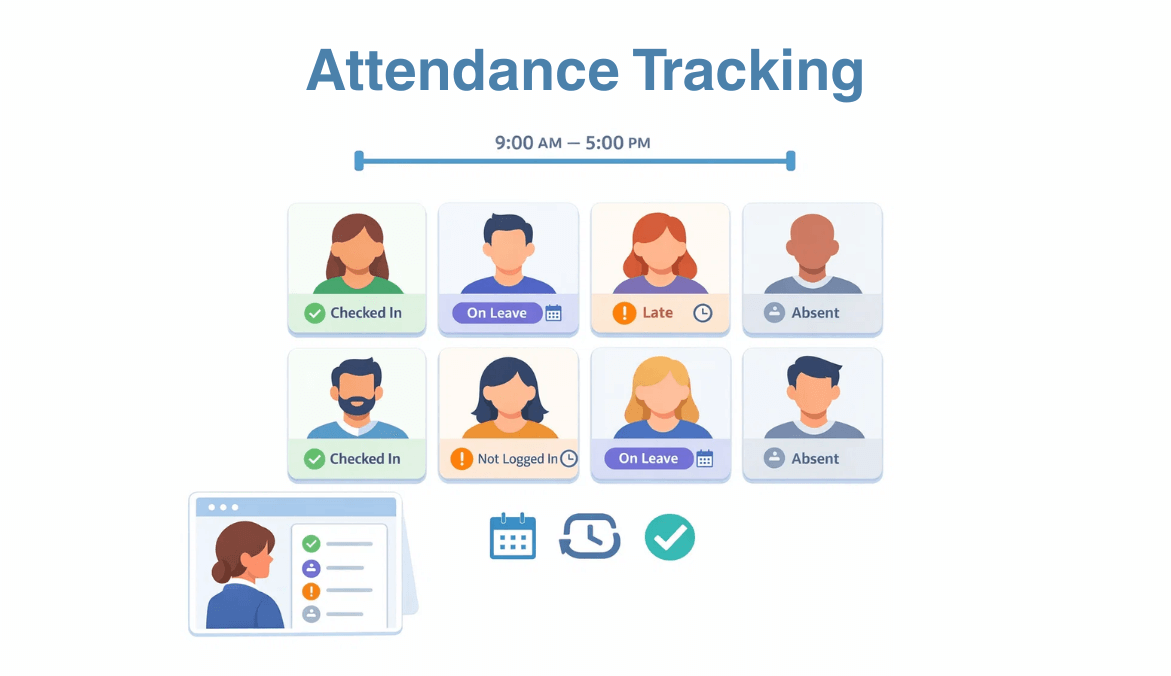
Attendance tracking is the process of recording when employees are present, absent, or unavailable during expected work hours. It helps organizations maintain consistency, support payroll accuracy, and ensure fair application of attendance policies—without measuring productivity or performance directly.
In short, attendance tracking answers “Was the employee available as expected?”—not “How productive were they?”
Why Attendance Tracking Still Matters in Modern Workplaces
Some leaders assume attendance tracking matters less in flexible or remote setups. In practice, the opposite is true.
Attendance tracking helps organizations:
- Maintain fairness across teams
- Avoid payroll disputes
- Meet compliance and labor requirements
- Set clear availability expectations
- Support planning and workforce visibility
Gartner research shows that companies using automated attendance and time tracking can cut payroll processing costs by around 30% , a significant ROI for HR and operations teams.
Experience insight: I’ve seen attendance issues cause more internal friction than performance issues—mainly because people perceive attendance as fairness. When expectations aren’t clear, resentment builds quickly.
Modern tools—such as digital attendance tracking within platforms like Mera Monitor —help replace guesswork with shared visibility, without turning attendance into surveillance.
How Attendance Tracking Works (Step-by-Step)
Step 1: Recording Attendance
Attendance is captured using one or more of the following:
- Clock-in / clock-out actions
- Login-based availability
- Shift-based schedules
- Remote attendance markers
The key is consistency—not complexity.
Step 2: Validation and Rules
Once attendance is recorded, it’s checked against predefined rules:
- Expected work hours
- Late or early logins
- Exceptions (meetings, field work, flexible schedules)
- Role-based attendance expectations
Experience insight: Manual systems often fail here. In many organizations I’ve worked with, the problem wasn’t attendance—it was inconsistent rule application, which led to disputes.
Step 3: Reporting and Payroll Support
Attendance data is summarized into:
- Daily or monthly reports
- Absence and leave records
- Payroll-ready summaries
According to research by Deloitte , adopting automated attendance tracking systems can reduce payroll errors by up to 60% , helping HR teams eliminate costly mistakes and improve payroll accuracy.
When done right, attendance tracking reduces arguments instead of creating them.
Attendance Tracking vs Time Tracking: What’s the Difference?
This confusion shows up in almost every organization.
- Attendance tracking measures availability
- Time tracking measures work duration
In fact, 96% of companies use attendance or time-tracking software , underscoring how ubiquitous these systems have become in modern workplaces.
Attendance answers: “Was the employee present during expected hours?”
Time tracking answers: “How much time was spent working on tasks or projects?”
For many teams, attendance tracking alone is sufficient. For project-based or billable work, time tracking becomes necessary.
Types of Attendance Tracking Systems
Attendance tracking generally falls into three categories:
- Manual systems
- Registers or sign-in sheets
- High error risk
- Spreadsheet-based tracking
- Slightly better control
- Still manual and inconsistent
- Automated attendance tracking software
- Accurate and consistent
- Scales with team growth
Tools like Mera Monitor is often used as enablers—providing automated attendance visibility while respecting role-based access and transparency.
Benefits of Automated Attendance Tracking
Automated attendance tracking helps teams:
- Reduce manual errors
- Apply rules consistently
- Improve payroll accuracy
- Minimize attendance disputes
- Scale without adding admin overhead
Experience insight: One consistent pattern I’ve seen: automation doesn’t reduce trust—it improves it, when employees know what’s tracked and why.
Common Attendance Tracking Challenges (and How to Handle Them)
Some common issues include:
- Employee resistance due to poor communication
- Confusion in remote or hybrid setups
- Over-monitoring concerns
- Policies that don’t match real work patterns
The fix isn’t stricter tracking—it’s clear policy + transparency .
Is Attendance Tracking Legal and Ethical?
In most regions, attendance tracking is legal when:
- Employees are informed
- Tracking aligns with work expectations
- Data access is role-based
- Policies are clearly documented
Ethical attendance tracking focuses on availability , not constant observation.
Attendance Tracking for Remote and Hybrid Teams
Remote teams change the rules slightly:
- Availability matters more than location
- Presence doesn’t mean “always online”
- Clear boundaries prevent burnout
Attendance tracking should support flexibility—not punish it.
Key Takeaway: Attendance Tracking Is About Visibility, Not Surveillance
- Attendance tracking ensures fairness and clarity
- It supports payroll and compliance
- Automation improves consistency—not control
- Transparency matters more than tools
Conclusion: The teams that succeed with attendance tracking aren’t the ones that track more—they’re the ones that communicate expectations clearly and track consistently.
When attendance tracking is implemented thoughtfully, it becomes a quiet enabler of trust rather than a source of friction.
 Gift Card ₹999